Sunday, 26 January 2025

They Came At Dawn


They came at dawn. At least, that's how I imagine it. The truth is, I don't know when the actual knock at the door happened. But sometime, they were woken up, or were already awake, bags packed, waiting. Weeks ago, when the latest race laws came into being, their windows had been broken by students from the local schools, graffitti sprayed on the outer walls, chants of 'Go to Palestine' shouted in the street. Since then, they were living on borrowed time. They must have known it.

What were their thoughts as the uniformed men led them from their comfortable home, where they had lived as valued members of their Jewish community? Grateful that their two boys, Kurt and Hans had escaped: one to Israel, one to Britain? Did Alma cry as she realised she would no longer be able to send food parcels to her youngest son, interned somewhere in England? Did Raphael, a devout orthodox Jew who prayed every morning and celebrated every Shabbat, thank G*d that Kurt would never again be taken down to the local police station and beaten up by the police, now that he and his new wife were safe in Israel ~ the country Alma and Raphael had tried to enter, but had been sent back to Nazi Germany by the British authorities as their 'paperwork' wasn't correct.


At the station, did they meet others, known faces? Did Raphael help his wife to clamber aboard the cattle truck, find a place to sit as it filled up with terrified families, all of whom would have been known to them? I try not to imagine that journey, days with little food, no water, perhaps a latrine bucket that would have slopped over onto the filthy straw. Human beings treated worse than cattle, robbed of their possessions and their dignity as the train bore them onwards out of their town, out of their country, toward the Polish concentration camp.


And then finally, the train arrived at its destination. The doors were slid back. I imagine men in uniforms shouting at them to get out quickly, snarling dogs straining on leashes, the elderly forced to jump down from the train, breaking their limbs as they fell. Sticks and batons raining down on terrified, exhausted, bewildered people as the cattle trucks disgorged their human cargo. Did they manage to stay together for those last few minutes? Look into each other's faces, touch each other before they were parted for ever, Alma led away to 'the showers', Raphael to whatever was to be his fate.


There is a Jewish tradition that every person dies three times: once when the body dies, once when the soul leaves the body, and a third time after the very last time that anyone still living says their names out loud. This is why every year, on the anniversary of their deaths, the names of family members are said aloud. It is called the yahrzeit

I do not know when Alma and Raphael died. I know where they died, and how they died. So on this 80th anniversary of the liberation of Auschwitz, on this Holocaust Remembrance Day 2025, I will remember them, my lost grandparents, and I will say their names out loud.

Alma Flatauer:


Raphael Flatauer:


The house still stands, still empty. The family who took it over, have  always refused to return it to us. But in front of the house, in full view of every passer-by, and in a perpetual memorial, are the two stolpersteine, marking the fact that a Jewish family, my family, once lived here.


© Carol Hedges 2025. No part of this blog, or family photos may be reproduced in any format without permission of the author.


Wednesday, 26 July 2023

The Adventures of L-Plate Bubbe: 'Speak the speech trippingly on the tongue'


So my Yiddish class is now on its annual break. This means that as a keen student and committed adult learner, it behoves me to continue working by myself over the Summer.

Thus I am ploughing on with Colloquial Yiddish (the textbook), commiserating with Dovid that his family are all totally meshuggeneh (mad) while admiring Chana's extensive apartment.

I have also purchased a Yiddish Dictionary & Phrasebook because it seemed like a good idea. Now, a quick recap: Yiddish is the lingua franca of the Jewish population (not all: in Israel they speak Hebrew). It is a universal way for Jews to be able to communicate with other Jews whose first language might be Polish, German, Lithuanian etc. 

My mother who worked for a Berlin-based refugee organisation trying to get Jews out of Germany before Hitler closed the borders, used to go to international conferences where Yiddish was the language employed by delegates and speakers. However, although it is a recognised language in many countries (Sweden, I learned recently), it has no country of its own. 

Like its speakers, Yiddish wanders the earth, refusing to be wiped out by events like the Holocaust and allowing itself to be mangled by people like me. This lack of a 'Yiddish country' is reflected in the phrasebook. For instance, search as I might, there are no phrases demanding consular access. 

However, on the plus side, the Yiddish Dictionary & Phrasebook does go into great detail about the three big Jewish concerns: food, health and how to complain. Other phrasebooks might have a few instructions on ordering a meal or dealing with an illness ... the Yiddish Dictionary & Phrasebook has PAGES! 

Dining out, 9 pages/ Food & Drink,13 pages
 If the food is too hot, too cold, not what you ordered, too expensive, too spicy, not spicy enough, if you want to sit over here, over there, by a window, in a corner, you think the waiters are inattentive, too attentive, if you have waited too long, if you want to pay separately, together, by cash, by cheque, by barter ... you will find a phrase.

Health, 20 pages
Similarly, if you have any minor, major, strange, unidentified, possibly fatal, ailment involving some body part, if you are limping, bleeding, allergic, vomiting, anaemic, constipated, need pills, potions, a bandage, a doctor, a hospital, medical attention of any sort there will be a phrase. Believe me. I have read them all.

Armed with these essentials, the Yiddish speaking traveller is equipped to confront the perplexities and problems of modern travel. Thus, if a fellow voyager asks Vos makst du? (how are you?) it is possible to reply with absolute accuracy. 

Similarly, an invitation to brontsh (brunch) or vetshere (dinner) can be accepted in the full knowledge that one's ability to kvetch (complain) is amply and fully catered for. Which, in essence, is all the Yiddish speaker needs to know.


Saturday, 1 April 2023

The Adventures of L-Plate Bubbe: Wine & Tears


This month (April) marks the festival of Passover (Pesakh in Yiddish), when Jewish communities and families remember the story of how the Jews, led by Moses, escaped from slavery under the Egyptian ruler Pharoah. It is a festival of joy at liberation, but sorrow at the suffering that preceded it. Passover always comes before Easter. There is a reason for this and I'll explain it shortly.

The festival is celebrated by a special family meal, called a Seder, which consists of prayers, blessings, songs, giving thanks for deliverance and looking forward to the coming of the Messiah. The photo shows my Passover plate: each of the little bowls represents some symbolic item relevant to the biblical story, which is told over the course of the evening, culminating in a lovely meal. 

(You can find out more about the plate and its symbolic contents here https://www.myjewishlearning.com/article/the-seder-plate/ )

The Passover meal was the one Yeshua (Jesus) took part in and is referred to in the Christian New Testament as 'The Last Supper'. This is where the two religions (or the extension of one by the other) coalesce. Christianity focuses on what happened AFTER the meal, but it is clear from reading the text, that it was a traditional Seder.

My family always used to attend synagogue for the Seder meal, which meant we kids had to behave better, couldn't leave the table for any reason whatsoever, and we got ribena instead of wine (such a disappointment). 

The whole concept of the Seder is not only to recall a very grim period in Jewish history, but to make sure the memory is passed on to future generations. Thus there is a point, early on in the celebration, when the youngest child asks 4 questions. They're called the Ma Nishtana, and revolve around querying why this night is different from other nights in food, in the way people sit at table etc. 


Every Jewish child in a religious household HAS to learn it, in case they end up being the youngest. I remember the sheer terror of realising one year that I was that child and I was going to be called upon to perform. I think being able to recite the Ma Nishtana is another of those Jewish identifiers, along with possessing your mother's recipe for chicken soup. 

It is also something that never leaves you. Even at the great age of 72, I can still, if prompted, recite the Ma Nishtana. If you are Jewish and reading this, I bet you can too!


Wednesday, 15 March 2023

The Adventures of L-Plate Bubbe: Homework (Jews do it backwards)


So, I have come to the conclusion that these gurus and so-called lifestyle experts who recommend learning a language in old age to keep the brain active, haven't actually tried it. As soon as a new piece of vocabulary arrives, one learned earlier disappears.

In nautical terms, we are Week 5: Still At Sea.

Luckily there are only three main tenses in Yiddish: present, past, and future, although I have discovered a fourth one, which creeps over me whenever I am faced with another piece of dialogue featuring Rokhel and Dovid, the Janet and John of my Yiddish primer.

For those who have never seen Yiddish on the page, it reads right to left, which meant initially I found myself writing the English translation back to front. Don't know what part of my brain that came from.

Then there is the vexed question of the vowels. In Hebrew, which I learned from age 7, and have now forgotten entirely, the vowels are lavish, plentiful and sit under the consonants like good helpful little soldiers. In Yiddish, they lurk in unaccustomed places or are absent without leave and you are just expected to know they are there. Even though they clearly aren't. 

The rest of the class marches on. I straggle behind them, laboriously spelling out the words letter by letter in a strangled whisper and hoping that the very sociable cat that belongs to one of the younger students will make an unexpected appearance on her screen, so we can all be distracted and I can catch up, albeit briefly.

For our current homework (Yiddish: heimarbet) we have been asked  to write about our family. The rest of the class, shiny-eyed and keen, have requested complicated lists of words like 'step grandchild', 'adopted daughter', 'same-sex couple' etc. My offering consists of four short sentences:

I have a husband. 

I have a daughter. 

She has 2 children. 

My parents are dead.


time in better get will it but


Thursday, 2 March 2023

The Adventures of L-Plate Bubbe: Bus Girls


Jews are probably the most travelled people on earth, and I'm not talking air miles here. From the Diaspora to today, they have schlepped their families and belongings from one country to another, building communities, setting down roots, starting businesses, and then at the whim of a ruler, a government or a baying mob, packing up and schlepping their stuff somewhere else.

I am in New York, having schlepped myself here via American Airlines. I'm not immigrating, I'm visiting family, but I know there have been Jews coming here since the 1840s, so I'm hoping to encounter some Yiddish speakers to try out my very basic attempts at speaking.

First attempt comes while visiting the Jewish Museum close to Central Park. I spot a couple of Jewish mums with their daughters. I edge closer and ask if they 'rednt Yiddish?'  One nods. I try a bit more. She frowns, corrects my pronunciation (Two is 'zway', not 'zwei' ~I have defaulted to German again). Discouraged, I move off.

Now it's my final day in the city. The kids are back at school and I'm on the Lower East Side, visiting The Tenement Museum, one of my favourite places. I lunch at Katz, managing to try out a few basic phrases, much to the amusement of the cutter serving me.

Then back on the bus. Two stops and a couple of women my age get on. They park themselves behind me and ... whoah! they start chatting to each other in Yiddish. At least I think it's Yiddish. Now's my chance. I turn round. Take a deep breath and launch out.  "Shalon aleichem. Ick heisse Carol. Ick com fum England," I say, smiling with fake confidence.

There is a pause. I am eyed thoughtfully. Then the greeting is returned, politely. I explain about learning Yiddish at 72, and why I'm doing it. The women (we'll call them Sara and Rokhel) smile back cautiously. There is another pause. The conversation founders. 

Then inspiration hits me. "Host du ayniklakh?" (Do you have grandkids?) Immediately, their eyes light up. They nod. Suddenly, the atmosphere changes completely. Phones are dug from handbags. Photos are found, passed round. I show them my pictures in return. We coo and admire.

And all at once, we are no longer three strangers; we are united in our love for our grandchildren. There is a word for this in Yiddish: naches. It means bursting with pride over a child's achievements. So here we are, three dames of the Diaspora, three bus bubbes, sharing a moment's naches on an uptown bus in New York

And it makes all my linguistic struggles totally worthwhile.

Tuesday, 14 February 2023

The Adventures of L-Plate Bubbe: The Tao of Chicken Soup


What makes me a Jew? It's a good question. And like everything else connected with Judaism, there isn't one single answer. Sorry. Look up an official definition and you get something like: Jews are an ethnoreligious group and nation originating from the Israelites and Hebrews of historical Israel and Judah. 

So, maybe that.

Jewish law (Halacha) states that to be Jewish, you have to be born of a Jewish mother, as the descent is matrilineal. However, the Bible (Torah) sees Jewish identity as patrilineal. 

See what I mean?

When I was applying to get my family's German citizenship 'restored' after the UK left the EU, the German government was only interested in whether my family's loss had occurred on my father's side. However when my brother's secular marriage broke down and he went frum, emigrated to Israel and subsequently wished to marry an Orthodox Jewess, my mother had to prove she had married in synagogue for it to be allowed. (The first marriage was discounted as the former wife was a gentile).

There are also various rules, complicated definitions, arguments, counter arguments etc. for people who decide to convert, or people who have one non-Jewish parent. We Jews love a good debate. We will kvetch and kibbitz until the sun goes down. And then some.

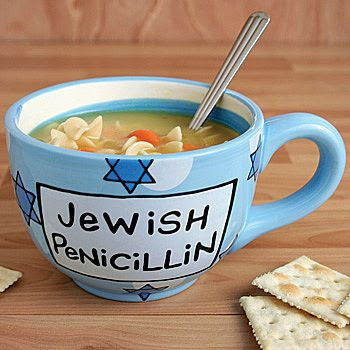
However, I believe there is one question that covers everything, and the answer to which proves definitely, once and for all time, whether you or I are really Jewish or not. And it is this: Do you have your mother's recipe for chicken soup?

I do.

                         My Mother's Chicken Soup

For this you will need a large pot, into which you put chopped celery, chopped onion, sliced carrots, then place on top a chicken (my mother used to actually pluck the chicken, then singe the remaining quills. I can still smell it). Add salt, peppercorns (my brother and I used to have a competition to see who had the most peppercorns: think 'Tinker tailor', Jewish style), and enough stock/water to cover the bird.

Slowly bring to the boil. Skim the fat off the surface ~ it's known as schmaltz, until the liquid is clear. Then cover and simmer very gently until the meat is so tender it falls off the bones.

Add some noodles to the pot and let them soften, just before dividing up the meat, the vegetables, and the lovely broth and placing it all in soup plates. My mother always served ours with thick slices of white bread to mop up the last of the soup.

Ess gezunterheit!


Monday, 6 February 2023

The Adventures of L-Plate Bubbe: Screentime


The last time I studied a language, I was 12 years old. I wore a pleated navy skirt, shirt and tie, and sat in a room with 28 other girls. Back then, the biggest problem was always where to sit. The swotty teacher-pleasers positioned themselves at the front, where they could show off their ability and get their hands in the air a micro-second before everyone else had processed the question.

The back row was reserved for the slackers and troublemakers, who passed the time creating their own charisma-free environment while contributing as little as possible to the class. I was the only Jewish girl in a school of 800, at a time where teachers could nickname you 'it', or refer to 'people like you' without being accused of antisemitism.

Therefore, my modus operandi was to maintain as low a profile as I could, which was why I always lurked in the middle of the fourth row, head down, studiously avoiding any eye-contact or engagement.

Beginners' Yiddish is not like this at all.

The first difference is that there is nowhere to lurk. The class consist of 7 students and teacher. We are all visible all the time. It is disconcerting to see oneself on screen, peering confusedly into the ether, as if I have developed an alter ego. The alter ego hasn't a clue what is going on. 

The other students are way ahead of me, some having done previous courses. If you have ever read 'The Education of Hyman Kaplan' by Leo Rosten, I am Mrs Moskovitch. I need a pre-Beginners' Yiddish course.

But this is lesson one, so it is too early to give up, even though I am reminded of all the differentiated worksheets I used to produce as a teacher for what were euphemistically referred to as the 'learning challenged', which is now me. 

I have learned two phrases, however: min nomen ist Carol (my name is Carol) and ich hob zer leeb ketzen, (I really like cats). On this basis, the cat thinks I have made a promising start.


Tuesday, 31 January 2023

The Adventures of L-Plate Bubbe : 'My Yiddish Notebook'


Before embarking upon any new enterprise, it is always good to do some pre-prep. This is especially true when one is about to begin learning a new language. 

Thus, while waiting for my Yiddish classes (Absolute Beginners) to start, I have decided to prepare myself for the challenges ahead by plunging straight in and acquiring some stationery. 

Yiddish is a polyglot language. Much of it derives from Hebrew and Aramaic, but there are also borrowings from German, French and Italian. Having established itself in Europe with the migration of Jews in the 10th century, the language did a bit more borrowing from various Slavic and Romance languages.

However, the Holocaust, when 6 million Jews were wiped out, almost marked the 'death' of Yiddish, as nearly all the main speakers were killed. To make matters worse, after World War Two, Yiddish as a spoken language by was banned by Stalin. So it looked for a while as though Yiddish would morph into another dead language.

But it lives.

What I particularly like about Yiddish is that it is the language of the home, spoken, taught and passed down by women. It exists in the female space. Hebrew is the language of the Torah, the Talmud, the Cheder ~ traditionally male spaces. Yiddish belongs to us women, to the kitchen, the table, the family gathered to eat and share.

With that it mind, I have chosen a notebook that contains all the colours of the rainbow, as Yiddish contains all the linguistic borrowings. And two pink pens. Because.

As for the title of this piece? There is a lovely Yiddish word ~ Schmaltz. It means (amongst other things) something very sentimental. When I was growing up, my parents possessed a scratchy 78rpm record of Sophie Tucker singing My Yiddishe Momme

If you copy the link you can listen to it here: https://www.youtube.com/watch?v=triCX77tl8s

Monday, 23 January 2023

The Adventures of L-Plate Bubbe: IN THE BEGINNING WAS THE BEGINNING


There are many reasons why one might decide to learn a new language in old age. The major one seems to be the incentive to stave off dementia. Struggling to master basic tenses and phrases in supposed to sharpen the synapses and keep the mind agile for longer. Ditto doing a daily Sudoku.

Neither of these is why, at the age of 72, I have decided to learn Yiddish. 

"Why are you doing this?" You Must Be Mad (now relocated to New York) asked, when I informed her this weekend, via Facetime, of my decision. "You should learn something useful."

I pointed out that I am reasonably fluent in French, can speak German as long as I don't think about it too hard and thanks to L-Plate Grandad's Italian classes, I have a smattering of Italian...though I have not mastered the pluperfect tense (neither has he).

My decision to learn Yiddish is visceral: it's the language of my tribe; it's part of my Jewish identity, which is being threatened, mocked, abused and belittled and generally ignored. Yiddish was the lingua franca of European Jewry, a way that all those in the camps could confer. My mother spoke it. My grandparents who died at Auschwitz spoke it. Now, I want to speak it too.

And there is another reason, less noble. Yiddish has probably the BEST insults and original curses of any language on earth. I mean, SERIOUSLY the best. English invective is like watered down milk in comparison. So when I tell some corrupt MP: "May you live to build yourself a house from your kidney stones" I want to be able to say it in Yiddish. Because it sounds so much better.

So I have signed up to an online language class in Basic Yiddish. It might take a while to build up to the cursing, but one has to begin somewhere. I start in 2 weeks. There will be updates. Watch this space.


Tuesday, 29 March 2022

VICTORIAN POVERTY: Coming to your neighbourhood soon


  "I was one day dealing with a case in which a poor woman was in great distress of mind because she had got some washing to do and had not the money to obtain the necessary materials wherewith to accomplish the work.

    "I shall lose eighteenpence if I can't get it done," she said, with tears in her eyes, "and perhaps lose other work too, for people who have washing to give out won't study you if you have to disappoint them."

"You don't look fit to stand at the wash-tub," I said, noting her weak and hunger-worn appearance.

"I could manage that all right," she exclaimed eagerly. "By working late I could get it done and take it home to-night, and then I could get something to eat out of the pay for it. As to eating, though," she added, " I am thinking more of the children than of myself. It is not often that we are so hard put to it, but this morning they had to go to school without breakfast, poor little things They knew it was my misfortune and not my fault that I had nothing for them to eat, and they tried to be brave and not to cry, but you could see their poor little lips quivering."
   
 I had every reason to believe that the woman was telling a literal and painful truth. Her husband was sober, and steady, and until a year previously had been a strong and capable labourer, able to command tolerably constant employment. But one day when engaged upon some heavy work he had, in labourers phrase, "overlifted" himself. From that time he had been, "off and on," an out-patient of various hospitals, and was practically an invalid.
    
"You had better get something to eat before starting your work," I said, in reference to her last remarks. "Here are two tickets, each for a shilling's worth of goods; they will enable von to get a little food, as well as the washing materials you require."


"Oh, thank you," she exclaimed, her face flushing with pleasure; "won't the little ones be delighted when they come home and find I have got a dinner for them?" - The Pinch of Poverty, by The Riverside Visitor


Saturday, 26 March 2022

The iPhone has landed!


As some of you know (see previous blog if you don't) I have recently parted company with a certain media platform, represented by a small winged blue avian. Now, I am NOT the sort of individual to reacts well to be chucked off stuff (also see previous blog), so having tried various return pathways, and being told '*itter says no', it was decided (note the distancing phrase) to buy an iPhone.


It seemed a good idea when suggested. I could join the 99.9% of the population. No more lurking about in the Doro cave. Bright new horizons of communication, bathed in the sunshine of up-to-dateness beckoned. I was seduced. My only stipulation was that the new phone had to be RED.


And it arrived. And it was red. And so the nightmare began. Going from the dumbPhone to this phone was like landing on a new planet without a Lonely Planet travel guide. In the past few days I have reached levels of incompetence so low you couldn't limbo under them.

1. I thought ALL these devices were called iPhones. Yup. Only was abused of this when I met a friend for coffee and was told that her phone was a Samsung.

2. You know that thing where the optician says: 'So, what's the lowest line you can read on the screen?' and your brain goes: 'What line?' That. They don't make these devices for the myopic, do they?

3. It doesn't like my cold finger (if you wish to sing 'Cold Finger' at this point, please don't). 

4. Autocorrect. The typist's worst enema. I bought a lovely jumper for Small in the sale, took a picture and sent it to You Must Be Mad in New York. The jumper was by Boden. NOT BIDEN - OK???

5. I have lost 25.8k lovely followers by being chucked off *witter. Given my lack of competence, I will probably never get them all back.

But. Rome wasn't burned in a day. And in 3 weeks, Little G (and Small) are coming to the UK for a visit, so I shall pick her brain, because even an 8 year old has to be more savvy than I am right now. Meanwhile it's a case of onward through the fog. Or  'frog' as autocorreect would probably say.


Friday, 18 March 2022

Places I've Been Banned From ~ An Odyssey


As the dust slowly settles on my Twitter ban, I am thinking about all the places I am or was not persona grata over the past 71 years. There are quite few. I am shocked.


1. The American Embassy 1966 : I only found out about this in retrospect. It came about as a result of an anti-Vietnam War demo a few of us organised on Welwyn Garden City Campus (that hotbed of revolution and radicalism). We were all banned for 10 years from entering the US. 'Paranoia strikes deep in the heartland' (Paul Simon.)


2. O Level Geography Class : Quote from Miss Walker: "I'm not having you in my class, you're disruptive." I have NO IDEA what she meant, other than I did get sent out of her class a couple of times, and used to hang from the window frame above the door, wiggling my fingers. She clearly didn't appreciate this impromptu gesture. But this is why, dear reader, I am unable to read a map without turning it round the way I am going, and I lose my car in multi-story carparks. All attributable to Miss Walker.


3. My family: It's what happens to Jews who 'marry out', especially if they didn't get on with their parents to begin with. This momentous event happened when I was 26. Apparently a rabbi was brought in, at the instigation of my Orthodox brother, and prayers were said over the dead. As in me. Their loss ~  my 'ex-parents' never got to meet my wonderful daughter.


4. Bits of the Parliamentary Estate: Post Brexit, the Met Police don't like us standing too close to the House of Commons etc. Or shouting. Whilst not technically a 'ban', I have been told off for chalking on the pavement outside the Cabinet Office too.


5. Harpenden Parents' Network Facebook Page: for daring to criticise posts by my Tory MP. Many of these 'local' pages are run by party loyalists, I gather. Luckily, St Albans still hosts me, so when we had a flood recently, I was able to access help.


6. Twitter: the latest ban. For being rude and hateful to a certain Home Sekertry. Come and say Hi to me on my new Instagram https://www.instagram.com/caroljhedges/ (or should that be Instagran?). I may be working my way back to Twitter, as I miss people, but it will be in another guise ...


7. The UK: Not happened yet ~ but if the Nationality and Borders Bill passes into law with Clause 9 re-inserted, the aforementioned Home Sekertry can take my citizenship away, without telling me or giving me the right of appeal. This is because 1: My parents came here as Jewish refugees, and like Windrush people, were naturalised, so not 'properly' British. 2. As a Jew, I could claim citizenship in Israel.


So there you are. Or in my case, there I'm not. It's pretty disgraceful and I am prepared to bet you can't equal it. Not that you'd want to, would you?


Saturday, 12 March 2022


BEING A GRANDMOTHER IS THE BEST JOB IN THE WORLD


I clearly remember the day the job started. It was summer. Bright sunshine pouring through the open window of my daughter’s London flat. We were visiting for Sunday lunch and making small talk with her lovely husband while she put the finishing touches to the meal.

Then my daughter walked in from the kitchen, carrying a dish of lasagne. She put it down on the table. She stood up and cleared her throat. ‘We have some news for you,’ she said and paused. ‘We’re expecting a baby.’

And for a second, the world stopped turning.

And then it started turning again.

But it was a new world.

I was the last of my group of friends to become a grandma. I’d congratulated, celebrated, commiserated. I’d cooed over other people’s baby pictures; peered into prams; helped them choose tiny clothes to give as presents; listened to their tales; nodded, smiled, and all the time, a small inner voice was just crying out: ‘When will it be my turn?”

The Job Begins

Ever since she turned one, I have looked after my gorgeous granddaughter two days a week from 7am to 7pm while my daughter returned to work. Currently my daughter is back home on maternity leave, having just given birth to my grandson. So now I mind ‘Little G’ for one day only.


Looking back over the past fourteen months, I have to say I never worked so hard, loved so hard, or laughed so hard in my life. I have never felt so exhilarated or so exhausted at the same time.


In the spirit of sisterhood, I offer the following thoughts for those who travel with me through this wonderful experience, or are about to start out on it.

9 Things I Love About Being a Grandma

#1: The overwhelming joy you feel when you first see your new-born grandchild.

#2: Realising that even after all those years you CAN still change a nappy and give a bottle.

#3: Sharing delight in a small stone, a bumble bee, a flower blooming in a crack in the pavement, a yellow school bus, an orange.

#4: Reaching into your bag for your mobile phone and finding:

  • Crumbs
  • A half-eaten packet of raisins
  • A green bottle top
  • A post it note with something you can’t read but it says Important at the top
  • An empty snail shell
  • A packet of crayons with one missing
  • A feather
  • Two toy cars

#5: Lying awake in the small hours just smiling and smiling over the memory of some funny thing that happened during the day. I started a blog to remember my special times with Little G. You forget so fast.

#6: Watching them enjoy eating the food you prepared for them.

#7: Singing the same song over and over because ‘again’ means ‘again’.

#8: Recalling that smile of triumph when they finally reach the top of the climbing frame all on their own for the first time.

#9: And best of all, two chubby little arms round your neck and a little voice whispering: ‘I love you, Grandma.’

So, are you a seasoned grandma or new one? Maybe you’ve just learned that you are about to become one for the first time? Please share your delights and joys of being a grandma in the comments below.

Thursday, 8 July 2021

THREE reasons to self-publish books


With imminent publication of the Ninth Victorian Detectives novel, Deceit & Desire, I have now moved into the entirely self-published category. And I been asked once again by several people why I decided not to stay with a commercial publisher.

Here are my reasons:


1. Control: As a self-published author, I  have a lot of autonomy. I can do whatever I like, publicity-wise, and if you follow me on Twitter (@carolJhedges) you will know that I do. I had very little autonomy with Usborne and OUP and I gather that some big publishing houses like to keep a close eye on their writers so they don't run amok on social media, which could rebound back on them. Also I gather that many houses prefer writers to promote other writers on their list (possibly why I rarely get promoted by Choc Lit writers, lovely though they are).

2. Choice: I  chose the wonderful Gina Dickerson ( @GinaDWriter ) of RoseWolf  Design to come up with my new covers. They are certainly quirky and different ... just like the stories .. and, dare I say it, like the author of the stories herself! When I was mainstream published, I had to accept whatever their in-house cover people produced whether I bought into the concept or not.

Also, I can choose and change the key words that help readers locate my books, and I can fiddle around with Amazon's book categories, if I want to. As I am an inveterate fiddler, I do.

3. Cash:  As a commercially published writer of adult fiction I was getting 40% of all ebook sales, far less on printed books. As a published children's writer that dropped to 12% of all book sales. And my then agent creamed off 10% on top of that. As Little G Books (my publishing imprint), I can command 70% of ebook sales. The difference in my monthly income figures has been remarkable.

Ok, I know it is all too easy nowadays to write a book, cobble together a cover and upload the finished product to Amazon. Advances in technology have opened up enormous opportunities for self-publishing that were never there when I started writing books, and that is a good thing.

I also acknowledge that inevitably, there is a lot of dross out there and it lets the side down. Poorly written and produced books with typos, badly designed covers, sold at rock bottom prices or given away for free, which is not the way I want to go.

However, despite the many ''Hey, I produced a book for virtually nothing'' blogs, the writers of the best self-published books have usually used beta readers, then paid out for professional editing, proofreading and cover designing. It is hard work at every stage, and having done it nine times now, I can attest to the pain.

But in a world where celebs are sneaking all the good publishing deals, and agents are less and less able to place books, if you can get an agent in the first place, I still think that going solo, if you can, is the best and most lucrative way of presenting your work to the reading public. And there is HUGE satisfaction from holding a book in your hand, or seeing it in a shop, and knowing that you produced yourself.


Sunday, 14 February 2021

A Letter from a Curious Citizen


 Dear Ms Patel

I know you are very busy at the moment processing thousands of applications from Hong Kong people with British National (Overseas) status plus their extended families, who have been given permission from you to settle in the UK. And then there are all the failed asylum seekers to be deported. I do appreciate that you have a lot on your desk. However, I wonder whether you can help me. You see, I remember what you promised when you were part of Vote Leave. 

You said: " There will be no change for EU citizens already lawfully res
ident in the UK. These EU citizens will automatically be granted indefinite leave to remain in the UK and will be treated no less favourable than they are at present. (June 1st 2016 /Vote Leave)

Now, your government's position seems to have changed. EU citizens are told to apply for pre-settled status, or for settled status. This is a complicated procedure, involving a lot of past records, documents, photocopies and certificates about employment, NHS, tax, and all sorts of things that some, particularly the very old, or the disabled or those who came here to live because they had that thing called Freedom of Movement (remember it?) just don't have. Your department says applicants must register on an Android device or an iPhone. Again, some people do not have these either. 

You have certainly managed to deviate a long way from your original pledge, haven't you, Ms Patel?

Setting all this aside (as you seem to have done with our human rights and your promises), I find myself in a bit of a dilemma. You see, I am a dual national ~ I was born here, of Jewish German parents who arrived in the 1940s as refugees. As I lost family members in the Holocaust, I have applied for, and recently been granted, 'restored' German citizenship. So now I am a citizen of here, and a citizen of there simultaneously. 

But you say that any EU citizen without pre- or settled status post 30th June 2021 may be removed from the UK. So here is my problem, Ms Patel: 50% of me (the German bit) does not currently have pre- or settled status, and will certainly not have it by the required date. I would therefore be grateful if you could inform me, as soon as possible, which part of me will be deported, so that I can make the necessary preparations and warn my family.

Yours sincerely

Carol Hedges (British/German dual national)


Saturday, 29 February 2020

You Don't Have To Be Jewish ...


Hello. My name is Carol and I'm a hypochondriac. I am also Jewish. You don't have to be Jewish to be a hypochondriac, but if you want to do it properly, being Jewish gives you a definite edge.

No, I don't know why. Maybe it's thousands of years of knowing we are the Chosen People while being constantly told to go and be chosen somewhere else. Listen, what do I know? Am I an analyst?

I do know that I spend a lot of time on the internet googling symptoms that I might have. And I mean A Lot of time. As a result, I have narrowly escaped a whole raft of illnesses, including some that are apparently only present in cattle.

Being a Jewish hypochondriac means that I always make sure I add 'and cancer' just before I click the search button. Because that is the constant fear, lurking within the true devotee to self-suffering.

Obviously, having actually had cancer twice, I have an edge on other Jewish hypochondriacs, and on you as well. But I don't want to brag, here. Let's just say, I am more Chosen in my self-imposed neuroses than the rest.

Which brings us to the IBS. I have just started a hashtag #JewswithIBS, because we ALL seem to have it. Mine, since the Brexit result, the election result and a couple of family things, got so bad that I finally referred myself to the doctor. There's only so long one can go without a proper meal.

Long story short: every test, every scan, every X~ray came back 'negative'. No cancer. Anywhere. So I was sent on my way with several prescriptions for tablets that might 'help'.

But. You know those 'Read all of this leaflet carefully' instructions you get inside boxes of medication. Well, I always do. Thoroughly. Because it's always interesting to get a list of ready-made symptoms to worry about. First perusal knocked out Medication 1 that advised not to take it if you had no appetite and were losing weight.

This left Medication 2, which I started taking regularly, checking the warning list of adverse reaction carefully. And guess what ~ within a week, I was 'developing' symptoms: tingly fingers, dizziness, nausea, and a presumed difficulty operating heavy machinery.

So now I have to google every single symptom separately, in case any of them are related to the incipient cancer that the tests didn't find, but might be lurking somewhere for all I know.

As for the current Coronavirus scare ~ it's coming up fast on the outside rail. I shall be getting round to worrying about it, once I am able to operate heavy machinery again.
    Sufficient unto the day is the hypochondria thereof.


Thursday, 6 February 2020

Rejoicing or 'Remoaning': How's your Brexit journey?


So how is it for you? Are you basking in those sunny uplands yet? Enjoying the gold dust of the Golden Age?  Celebrating your newfound status as OfBoris?

Me neither.

As many of you know, three years ago, as a direct result of the Referendum outcome, I applied for, and got, restored German citizenship, as my Jewish parents were forced to flee their birth country and my grandparents Alma and Rafaele were rounded up and sent to Auschwitz. You can read about it here.

What I did not realise at the time, was that the after-effects of the Holocaust were felt not only by those who survived the camps, or escaped from Nazi Europe, but can be tracked, by some process I do not comprehend, in those born later.

In combat terms, it is like having PTSD. Another description could be 'survivor guilt'. For Jews like me, born to parents who got out of the utter hell that was Nazi Germany, it manifests as a constant reminder that however safe we feel, there lurks in the shadows of our past, a time when a whole nation lost its reason, when millions of people who had done nothing more than not be 'them', were denied basic human rights and dignity, rounded up, starved, worked to death, experimented on, or shoveled into huge ovens and gassed.

And we were told, over and over, by concerned parents and relatives that the time could easily come again, if the right circumstances and the wrong leaders align.

Listen, I grew up on stories of the gradual indifference of neighbours, the relentless seeping into public consciousness, via a carefully controlled media, that certain races and religions were responsible for all society's problems, and needed to be expunged from the face of the earth. I lived with it. I still do.

But back to you. How's your journey? Did you just shrug when the media was full of photos and video clips of Union Jack-waving white guys setting fire to EU flags and singing Rule Britannia? Were you concerned when certain journalists were banned from government briefings? Does it worry you that attacks on EU citizens (and Jews) have now become so frequent, they almost don't register as shocking any more?

You should be worried.

We, who carry the horrors of the past in our DNA, are lighting our candles and stepping out into the encroaching darkness, and as we hold them up in front of us, we can clearly see shapes and contours that are both alien and strange, and yet chillingly familiar at the same time.


Wednesday, 22 January 2020

The Joy of Buses


I have written several pieces about the Joy of Buses. Basically, since getting my Freedom Pass, and selling the 2CV, I have taken to using local buses whenever I can because, apart from being ecologically better for the planet than other forms of transport, they are a source of great fun and adventure.

And there is so much fun to be had.

For instance, we regulars really enjoy it when we get a brand new driver who doesn't know the route too well. We all have a tacit agreement not to say anything when they go down the wrong road, because we like to see where we will end up. OK, it is a bit irresponsible, and yeah, we are sorry afterwards. Just not very sorry.

The other main source of amusement comes from the invisible bus stops. These are places where the bus has to stop, but for some reason, there is no actual bus stop to indicate it. There is a bus stop on the opposite side of the road, which has a timetable for 'the bus stop opposite', which gives the invisible stop viability, but there is no physical bus stop. We don't know why, but there are several on the main route into town.

The following true, if surrealistic, story took place last week, and to understand it, you have to factor in some roadworks, which meant that one of the regular bus stops was closed and moved 20 yards down the road to a 'temporary stop', chained to a lamp post so that the locals couldn't walk off with it, place it outside their houses and then complain to the bus company that the buses weren't stopping there. I am pretty sure this isn't why the temporary stops are chained to lamp posts, but it's what I'd do, given half a chance if they weren't.

I was on the bus with regular passenger and friend Rita. We rang the bell to get off, but the driver completely ignored us and kept going. Cue loud shouting from the back of the bus. Eventually the driver stopped. We made our way up the bus to his cab and pointed out that we'd rung the bell.

Driver (new one): I didn't stop the bus because there's no bus stop.
Me: There is a bus stop, it's just that it isn't an actual stop.
Rita: Look, there's a bus stop over the road, so there's a stop over here. That's how it works.
Driver: But there isn't a stop over the road.
Rita: It's only because it's been moved temporarily coz of the road works.
Me: And the stop on this side, that isn't an actual bus stop, hasn't been moved.

At which point the driver rolled his eyes, gave up, opened the doors and we got out. We decided to chalk it up as a point to us, because it was and WE are the bus queens!


Monday, 23 December 2019

Last Christmas I Gave you My Heart (Adventures of L-Plate Gran)


In answer to your unasked question: Little G's Nativity Play went down a storm. No baby was dropped. Small waved copiously and Grandma was so glowing with pride, you could have run the lights off her.

And so to Christmas. Excitement is building in You Must Be Mad's house. The tree is up. Small has not, so far, removed any of the decorations, as he did last year when he took a great fancy to a small felt dinosaur, which kept getting rescued, returned, and re-stolen.

This year, we are hosting the family, and I have decided to go for ecologically sound decorations of a 'growing in the garden' variety, so there is trailing ivy up the stairs, and holly, bay and rosemary festooning the dresser and pictures.

Christmas lunch will be a feast. Due to Small's veg phobia, diplomatic negotiations will take place beforehand over the number of peas deemed acceptable. L-Plate Granddad will set light to the Christmas Pudding, despite Health & Safety warnings, and everybody will don paper hats and tell cracker jokes that Small won't get.

However. There is a spectre at the feast. Next year, Little G & Small will be moving with You Must Be Mad, to New York to live. Six years of sharing our lives and having adventures together is going to come to an end. And under the jollity and rejoicing, the greenery, the presents, the food and fun, there will be two very broken adult hearts at the table.

But the show must go on. And it will. Because it has to.

Happy Christmas, everyone ....


Tuesday, 3 December 2019

Christmas Capers (Adventures of L-Plate Gran)


It has been some time since I wrote about Little G and Small. Much has happened since then. For Little G and Small, growing up has happened. Small is 3 and fighting a rear-guard action against all attempts to make him eat vegetables. Little G is 5 and at her local primary school.

Reception whizzed by in a flash for Little G, and now here she is in Year 1 ~ or 'Key Stage 1' as it is called. She reads exceptionally well, but thanks to the *wonderful* National Curriculum, has no literary appreciation of what she is reading. 'What did you like about that story?' I ask after we've shared a wonderful Michael Morpurgo book about a robin. Pause. 'I saw some digraphs and trigraphs,' she says.

I will be undermining the curriculum at every stage, believe me! But that is for later on. Right now, Christmas approaches and it is time to prepare for the school Nativity Play. Last year, Little G was one of 30 innkeepers, with the rest of Reception. They wore an assortment of tunics, the ubiquitous striped tea towel head-dress and sang a jolly song about there being 'No room' at the inn, bad luck!'

This Christmas however, Little G has been selected to be Mary and we are all at peak pride. In the week, her costume arrived from school: a long pale blue dress with sparkly bits, a head-dress and a cape. If you discard the head-dress and cape, the costume can double hat as Elsa's costume from Frozen.

The ensemble was also accompanied by a Baby Jesus doll. Little G has practised holding it in such a way as not to worry any new mums in the audience. When she isn't practising, Small, who has taken rather a shine to the doll, likes to shove it down his jumper and pretend to give birth to it. That's how we roll.

We have tickets for the first performance. So next Tuesday, L-Plate Granddad and I will take our place in the school hall with other parents, grandparents and family members to watch Little G's second Nativity Play. And it will be funny and brilliant and heart-stoppingly wonderful, all at the same time. Because it always is.

Nativity 2 ~ believe your journey.